Blog
Sprained Ankle vs. Broken Ankle: How to Know the Difference
Every year, ankle injuries send millions of people rushing to the nearest clinic or emergency room and most of them arrive with the same


When dealing with something as critical as your circulatory system, choosing the right specialist can impact your health outcomes in significant ways. Many patients with vascular conditions may be uncertain, should they see a vascular surgeon, a cardiologist, or a radiologist?
At SFL Medical Group, we believe in empowering people with clear information to make confident healthcare decisions. Let’s explore why choosing a vascular surgeon rather than an interventional cardiologist or radiologist may be the most comprehensive and effective choice when it comes to vascular care.
Before diving into why one might be preferable to another, we need to understand what each of these medical professionals do and how their core competencies differ.
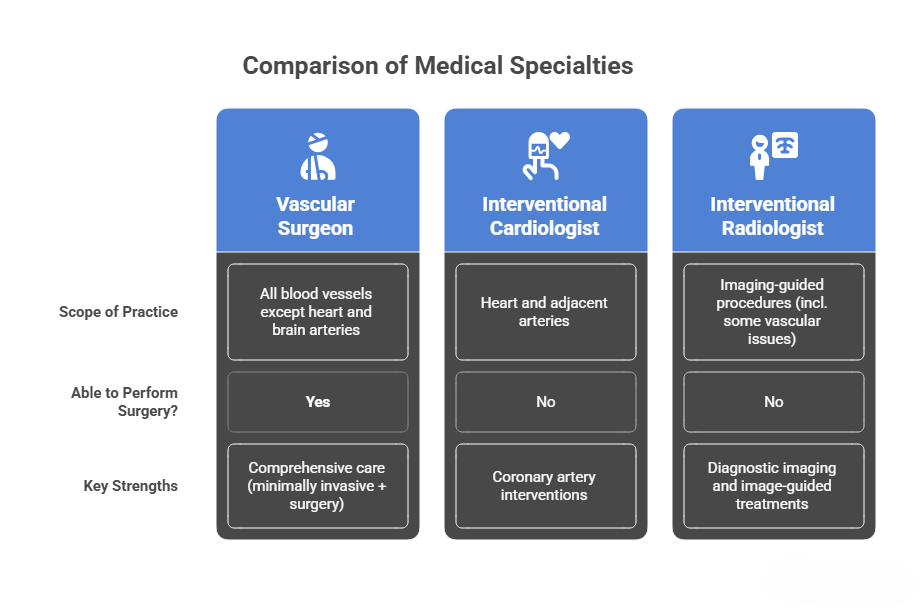
Vascular surgeons specialize in diagnosing, managing, and treating disorders of the full vascular system such as arteries, veins, and lymphatic vessels excluding the heart and brain.
They are trained not only in minimally invasive procedures but also in traditional open surgery. This versatility means they can offer the best treatment for your specific condition, not just the one they are qualified to perform.
Interventional cardiologists are internists or cardiologists who sub-specialize in treating cardiovascular diseases, primarily inside the heart and nearby arteries. While they may perform vascular procedures like balloon angioplasty or stents, these are often limited to larger arteries (most commonly the heart or leg arteries).
Interventional radiologists use medical imaging to guide minimally invasive treatments. They treat a variety of conditions, ranging from uterine fibroids to certain vascular disorders like varicose veins or deep vein thrombosis. However, they’re generally not surgeons and don’t perform open vascular surgeries.
Vascular surgery is a deeply technical and highly specialized field. To become a vascular surgeon, physicians undergo:
This extended training ensures that vascular surgeons can expertly manage both routine and complex cases including life-threatening aneurysms, carotid artery disease, and limb-threatening peripheral artery disease.
Interventional cardiologists and radiologists, on the other hand, typically do not have surgical training. Their scope is limited to catheter-based or image-guided procedures. If something goes wrong, or your condition requires surgery, patients often need to be referred elsewhere, to a vascular surgeon.
When you work with a vascular surgeon, we lead every step of your treatment journey from initial diagnosis to surgery or minimally invasive procedure and post-operative care. There’s no hand-off between different specialists. That continuity leads to better communication, fewer complications, and improved patient satisfaction.
Patients with diabetic wounds, venous insufficiencies, or aneurysms often have complex needs. Vascular surgeons aren’t just technicians, we provide holistic management, including lifestyle recommendations, long-term surveillance, wound care, and prevention strategies.
Time is critical in emergency vascular situations like ruptured aneurysms or acute limb ischemia. Vascular surgeons are hospital-based and trained to respond immediately. On the other hand, interventional radiologists or cardiologists might not be readily available or trained for emergency open surgeries.
Choosing a vascular surgeon at SFL Medical Group means you’ll have rapid access to diagnosis, intervention, and if needed, surgical repair all in one place.
You should consult a vascular surgeon if you have:
Remember: vascular issues often overlap and evolve. A vascular surgeon ensures your care evolves alongside them.
Absolutely. At SFL Medical Group, we regularly collaborate with interventional cardiologists and radiologists. For example, if a patient has both coronary artery disease and peripheral artery disease, we may work alongside a cardiologist to address both safely.
But when it comes to vascular care alone, a vascular surgeon offers the most complete, safest care for both minimally invasive procedures and major surgeries.
Not all vascular issues can be treated with stents or medications. We owe it to patients to look beyond trendy procedures and ask, what’s best for this individual? Vascular surgeons provide the full range of options, balanced perspective, and crisis-response readiness that’s hard to find in other specialties.
At SFL Medical Group, our vascular surgeons are not just experts. We’re partners in lifelong vascular health.
Every year, ankle injuries send millions of people rushing to the nearest clinic or emergency room and most of them arrive with the same

Claw Toes: What Is Really Going on With Your Toes? When lesser toes curl downward and dig into shoes, walking can go from effortless to