Why Vascular Imaging Matters More Than Most People Realize
Blocked or weakened blood vessels often stay silent until something serious happens. Many patients in South Florida feel fine on most days, yet imaging shows critical narrowing in leg arteries or a bulging abdominal aorta that could rupture without warning.
Vascular imaging gives us a window into arteries and veins before they cause life-altering events like stroke, limb loss, or aneurysm rupture. For patients in Miami with higher rates of diabetes, high blood pressure, and smoking exposure, choosing the right vascular imaging test at the right time can make the difference between a routine procedure and an emergency.
What Is Vascular Imaging?
Vascular imaging includes any test that lets us see your arteries and veins. We use it to answer questions such as:
Is there narrowing or blockage from plaque or a clot?
Are there bulges (aneurysms) or structural weaknesses in a vessel wall?
Is blood flowing in the right direction and at the right speed?
Are varicose veins or venous insufficiency causing symptoms like swelling or pain?
Is a prior stent, bypass graft, or surgical repair still functioning?
Different technologies show different aspects of the vascular system. Ultrasound shows how blood flows in real time. CTA and MRA show detailed 3D pictures of vessel anatomy. Catheter angiography visualizes vessels from the inside and allows immediate treatment in many cases. Our role is to match the question with the right tool.
Key Vascular Imaging Options in Miami
Vascular Ultrasound and Doppler Ultrasound
Vascular ultrasound uses high-frequency sound waves to create images of vessels near the skin surface. Doppler ultrasound adds color and velocity measurements to show direction and speed of blood flow. The process is painless and does not use radiation or injections.
Common Vascular Ultrasound Studies
Carotid ultrasound – evaluates arteries supplying blood to the brain and looks for plaque, narrowing (stenosis), and unstable lesions that may cause stroke
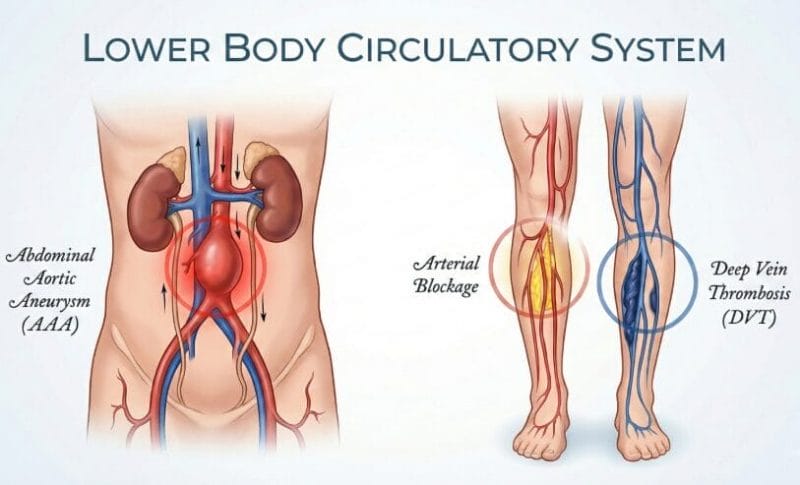
Venous duplex ultrasound of legs or arms – evaluates for deep vein thrombosis (DVT) and assesses venous insufficiency and varicose veins
Arterial duplex ultrasound of legs – screens for peripheral artery disease (PAD) and helps determine severity of blockages
Abdominal aortic ultrasound – screens for abdominal aortic aneurysm (AAA), often in older smokers or former smokers
Why We Like Ultrasound
No radiation
No contrast dye
Widely available at many Miami imaging centers
Lower cost compared with CTA or MRA
Real-time flow information
Limitations of Ultrasound
Limited view of deeper or more complex anatomy (chest, pelvis, some abdominal vessels)
Image quality depends on operator skill and patient body habitus
Cannot always map entire vascular tree as precisely as CTA or MRA
CT Angiography (CTA)
CT angiography combines a standard CT scanner with intravenous contrast dye to make arteries and veins light up on imaging. A CT scanner takes many thin X-ray slices in seconds, and computer software reconstructs those slices into 3D images of the vessels. The scan itself usually takes less than 10 minutes.
Typical Uses of CTA
Detailed arterial mapping before interventions such as peripheral artery stenting, bypass, or aortic aneurysm repair
Evaluation of acute symptoms such as sudden severe chest, back, or abdominal pain suspicious for aortic dissection
Brain and neck vessel evaluation including intracranial aneurysms and severe carotid disease
CT pulmonary angiography (CTPA) for suspected pulmonary embolism
Benefits of CTA
Rapid and widely available at most hospital-based and independent imaging centers
High spatial resolution and excellent 3D reconstructions
Helpful for difficult-to-image areas like chest, abdomen, and pelvis
Risks and Considerations
Uses ionizing radiation
Requires iodinated contrast, which can affect kidney function in vulnerable patients
Not ideal for patients with advanced kidney disease unless carefully weighed against risk
MR Angiography (MRA)
Magnetic resonance angiography uses a strong magnetic field and radiofrequency pulses to generate detailed vascular images, often without radiation. MRA can be performed with or without gadolinium-based contrast. Scans usually take longer than CT, but some centers offer open or wide-bore MRI options for patients with claustrophobia.
Where MRA Fits Best
Brain and neck vessels – intracranial aneurysms, arteriovenous malformations, carotid and vertebral artery disease
Aorta and large vessels – thoracic aortic aneurysms, dissections, complex congenital vascular anatomy
Peripheral arteries – noninvasive mapping of leg arteries in patients where CTA is not ideal
Key Advantages
No ionizing radiation
Excellent soft-tissue contrast and vessel detail
Non-contrast options exist for patients with significant kidney issues
Considerations and Limits
Longer scan times and patients must stay still
Some cannot undergo MRI due to certain pacemakers, defibrillators, metal fragments, or older implants
Gadolinium contrast carries specific risks in severe kidney failure
Availability can be more limited than CT at certain Miami centers
Catheter Angiography (Conventional Angiography)
Catheter angiography is an invasive procedure performed in a specialized suite. A physician threads a thin catheter into an artery (commonly in the wrist or groin), injects contrast dye directly into targeted vessels, and takes real-time X-ray images. Unlike other imaging methods, catheter angiography often provides both diagnosis and treatment in the same session.
When We Rely on Catheter Angiography
Noninvasive tests show significant narrowing that likely needs treatment
A limb is threatened due to severe PAD, non-healing ulcers, or gangrene
Aneurysm repair, stent placement, or other endovascular intervention is planned
Embolization is needed to control bleeding or treat vascular malformations
Treatment Options During Angiography
Stent placement to reopen narrowed arteries
Balloon angioplasty
Clot removal with specialized devices
Targeted medication delivery (for example, clot-busting drugs)
Sealing off abnormal vessels or aneurysms with coils or plugs
Risks and Recovery
Bleeding or bruising at the access site
Rare risk of vessel injury, stroke, kidney stress from contrast, or allergic reaction
A few hours of post-procedure monitoring and temporary activity limits
How We Work With Imaging Centers in Miami
We have certain imaging equipment that helps our patients with in-house diagnostics but if the patient requires any imaging tests done which cannot be done in-house at SFL, We refer them to our trusted partners who are based in Miami to complete the tests, We choose our partner carefully and they are reputable and trusted by our panel of doctors.
Our Approach to Referrals
We match patients with centers based on:
Type of test needed (ultrasound vs CTA vs MRA vs angiography)
Urgency (same day, 24 to 48 hours, or routine)
Insurance contracts and out-of-pocket costs
Patient location and transportation needs
Special requirements such as open MRI, sedation, or language support
We also communicate the clinical question clearly to radiologists, request specific protocols when appropriate, and track imaging reports to integrate results into your overall vascular treatment plan.
How We Keep Patients Safe
Many patients in Miami already live with diabetes, hypertension, or chronic kidney disease. Those conditions increase our responsibility to choose tests carefully.
Contrast Safety
For iodinated contrast (used for CTA and many angiographies), we review kidney function and prior reactions before ordering. For higher-risk patients, we may recommend pre- and post-procedure hydration and alternative imaging when appropriate. We coordinate with imaging centers that follow American College of Radiology (ACR) guidelines.
For gadolinium contrast (used for MRA), we check kidney function and avoid or limit specific agents in advanced kidney disease. We consider non-contrast MRA techniques when possible.
Radiation Safety
Ultrasound and MRA without contrast do not use ionizing radiation
CTA and catheter angiography do use radiation, so we do not order them lightly
When CTA or angiography is indicated, we choose imaging centers that use modern equipment and dose-reduction protocols
How SFL Medical Group Supports Your Vascular Journey
Our attention stays on what benefits you:
Objective decision-making – we are not incentivized to steer you toward one test over another for financial reasons
Tailored referrals – we recommend imaging centers across Miami based on their strengths, technology, and your insurance realities
Integrated care – we align imaging results with cardiology, vascular surgery, neurology, endocrinology, podiatry, and wound-care services as needed
Long-term follow-up – for conditions like carotid disease, PAD, and aneurysms, we help plan surveillance schedules and adjust treatment over time
If you already have imaging from another facility, we review those results, often request the actual images, and decide whether additional or repeat testing is truly necessary.
When to Talk With Us About Vascular Imaging in Miami
We will not send you for unnecessary tests. When imaging is appropriate, we will help you navigate where to go, what to expect, and how results shape your next steps.
Dr. Paul Hanna is a board-certified vascular surgeon with specialized fellowship training in complex vascular interventions and minimally invasive endovascular techniques. He serves as Director of Vascular Surgery and General Surgery at South Florida Multispecialty Medical Group, with over a decade of experience treating vascular conditions affecting the limbs, aorta, and peripheral arterial system.
Ankle injuries are among the most common musculoskeletal problems in the United States, affecting athletes, weekend warriors, and everyday individuals alike. An estimated 25,000