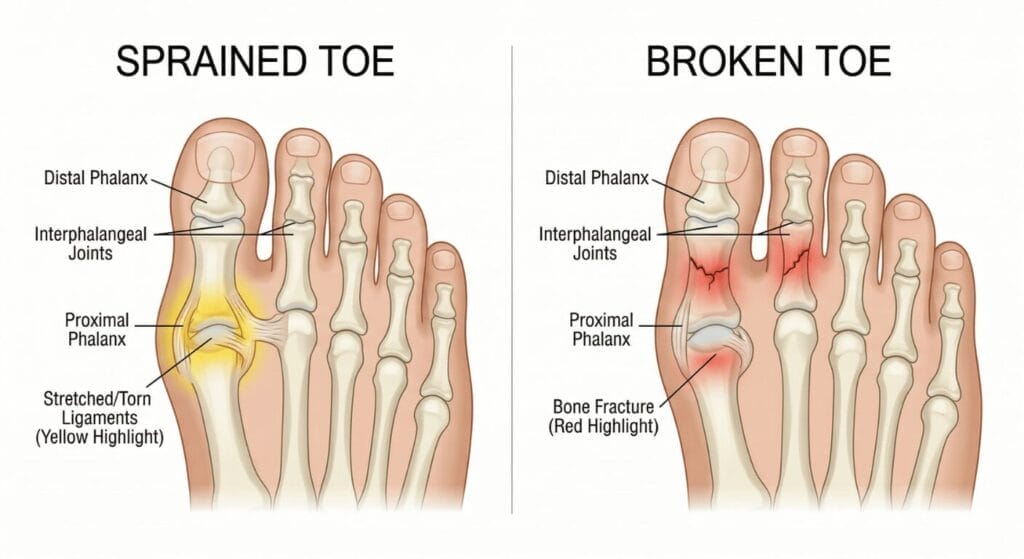
Roughly 8 to 10 percent of all fractures treated in emergency departments involve the foot and toes, yet a significant number of patients walk away thinking they “just jammed” a toe, when the truth is more serious. Knowing the difference between a sprained toe and a broken one is not just a matter of curiosity. It directly shapes the treatment path, the recovery timeline, and whether you end up with a fully healed foot or a lingering problem that resurfaces every time you put on a pair of shoes.
At South Florida Multispecialty Medical Group, our podiatric team sees both types of injuries regularly. We want to give you a clear, medically grounded breakdown of how to tell them apart and when it is time to stop guessing and come see us.
Understanding What Is Actually Injured
Before we compare symptoms, it helps to understand the structural difference between these two injuries.
What Is a Sprained Toe?
A sprained toe is a ligament injury. Ligaments are the tough, fibrous bands of tissue that connect bone to bone and stabilize your toe joints. When you forcefully bend, twist, or hyperextend a toe, whether from an awkward landing during sports, stubbing it hard against furniture, or catching it on an uneven surface, those ligaments stretch or tear. The injury is real, painful, and worth treating seriously, but the bone itself remains intact.
What Is a Broken Toe?
A broken toe (also called a toe fracture) is a break or crack in one of the small bones of the toe, called phalanges. Each toe contains two or three of these bones. Fractures typically happen through direct trauma, dropping something heavy on your foot, kicking a hard object at speed, or during a fall. Stress fractures can also develop over time from repetitive loading, especially in runners and dancers. When the bone breaks, the structural integrity of the toe is compromised, and the injury demands a different level of care.
Sprained Toe Symptoms: What to Look For
Toe sprains are classified into three grades based on the extent of ligament damage. Recognizing your grade helps set realistic recovery expectations.
Grade 1 (Mild Sprain)
Ligaments are stretched but not torn. You will notice minor tenderness and mild swelling, but the toe remains functional. Walking is uncomfortable but still possible, and symptoms tend to improve noticeably within a few days of rest.
Grade 2 (Moderate Sprain)
A partial tear of the ligament is involved. Swelling and bruising become more pronounced, and moving the toe through its normal range feels painful. Weight-bearing is difficult, and recovery typically takes three to four weeks with proper care.
Grade 3 (Severe Sprain)
This involves a complete ligament tear. Pain is intense, swelling is significant, and movement in the affected toe is nearly absent. Grade 3 sprains can take six to eight weeks or longer to heal and may require physical therapy or, in rare cases, surgical intervention.
Across all three grades, the pain from a sprained toe tends to feel more generalized, spread through the toe and its base, and is typically a throbbing, aching sensation that worsens when pressure is applied or when you attempt movement. Crucially, even with a severe sprain, some degree of movement in the toe is usually still possible.
Broken Toe Symptoms: When the Bone Is Involved
A broken toe announces itself differently. Here is what patients with fractures commonly report:
Immediate, sharp or throbbing pain at the site of injury
Rapid swelling that often exceeds what you would see with a sprain, sometimes extending into the foot
Bruising that may spread further along the toe and even down toward the midfoot, often appearing as a deep bluish-purple discoloration
Significantly limited range of motion or the complete inability to move the toe
Pain that is more localized, meaning you can often point directly to where the break is
A visible deformity where the toe appears crooked, bent at an unnatural angle, or misaligned compared to the other toes
A cracking or snapping sound at the moment of injury
Burning or tingling sensations, and sometimes numbness, indicating nerve involvement
Pain that does not improve after two to three days of rest and elevation
Bleeding under the toenail (subungual hematoma), which is a particularly telling sign in fractures of the end bone of the toe
One important caveat: many people assume that if they can walk on a toe, it is not broken. That assumption can lead to delayed treatment. While a sprained toe typically still allows some weight-bearing with discomfort, a stable (non-displaced) fracture can also permit limited walking. The ability to walk does not rule out a fracture.
Side-by-Side Comparison: Sprained Toe vs. Broken Toe
Feature
Sprained Toe
Broken Toe
Structure Injured
Ligament
Bone
Pain Type
Throbbing, aching, generalized
Sharp, localized, intense
Movement
Painful but some movement remains
Minimal to none
Swelling
Moderate, centered at joint
Severe, may spread to foot
Bruising
Localized around injury
Extensive, deeper coloration
Deformity
Usually none
May appear crooked or misaligned
Sound at Injury
No audible cue
Possible crack or snap
Numbness/Tingling
Uncommon
Can occur with nerve involvement
Bleeding Under Nail
Rare
Common in distal fractures
Weight-Bearing
Possible with discomfort
Often very difficult or impossible
Healing Time
1 to 6 weeks depending on grade
6 to 8 weeks on average
The One Test That Removes All Doubt
Even experienced clinicians will tell you that, without imaging, distinguishing a sprain from a fracture can be genuinely difficult, especially in the acute phase when everything is swollen. The definitive answer comes from an X-ray, which takes only a few minutes and provides a clear picture of bone integrity. In some complex cases, particularly involving the big toe joint or suspected stress fractures, an MRI or CT scan may add further detail about soft tissue damage or subtle fracture lines not visible on standard X-ray.
If there is any question about whether your toe is broken, getting imaging done sooner rather than later is always the right move. Our ankle and foot fracture care team at South Florida Multispecialty Medical Group offers in-office imaging to help you get answers quickly.
When to Seek Immediate Medical Attention
Not every stubbed toe requires an emergency room visit. However, there are specific situations where you should seek professional evaluation promptly:
The toe appears visibly deformed, crooked, or pointing in the wrong direction
You hear a snapping or cracking sound at the moment of injury
Bone is protruding through the skin (open fracture — this is a medical emergency)
Numbness, tingling, or a cold sensation develops in the toe
The toe turns a deep bluish-purple or blue-black color
You cannot bear weight on the foot at all
Significant swelling does not improve after 48 hours of RICE therapy
Bleeding under the toenail develops
Any toe injury in a patient with diabetes or peripheral neuropathy, as complications in these patients are far more serious
Big toe injuries also warrant faster evaluation. The big toe absorbs enormous force during walking and running. A fracture here that is not properly managed can compromise your gait, balance, and long-term foot function in ways that smaller toe fractures do not. If you have recently suffered a big toe injury, read our detailed guide on dislocated big toe treatment to understand what to watch for.
Treatment: What Happens Next
Treating a Sprained Toe
The cornerstone of sprained toe treatment is the RICE method, Rest, Ice, Compression, and Elevation, applied in the first 24 to 72 hours. Beyond that, treatment depends on the grade of the sprain.
For Grade 1 and Grade 2 sprains, buddy taping (gently securing the injured toe to its neighbor for support), anti-inflammatory medications, and wearing a stiff-soled shoe are typically sufficient. Early, gentle movement is often encouraged in mild to moderate sprains to promote circulation and prevent stiffness.
Grade 3 sprains with complete ligament tears may require a walking boot, physical therapy, and in rare cases, surgical repair of the torn ligament. A structured rehabilitation program, including range-of-motion exercises, strengthening, and proprioception training, is critical to full recovery and prevention of chronic instability. Our ankle sprain treatment page covers the full spectrum of ligament injury care available at our practice.
Treating a Broken Toe
Broken toe treatment focuses on stabilizing the bone so it heals in proper alignment. The approach depends heavily on which toe is broken and how severe the fracture is.
For stable, non-displaced fractures of the smaller toes, buddy taping combined with a rigid-sole protective shoe is often all that is needed. The bone typically heals in six to eight weeks with conservative care.
For the big toe, which bears significantly more biomechanical load, a walking boot or cast may be prescribed for the first two to three weeks, followed by a rigid-soled shoe for an additional three to four weeks.
Displaced fractures, where the broken bone ends are no longer aligned, require manual reduction (realignment) under local anesthesia, followed by immobilization. In more severe cases, particularly when the fracture involves the joint or fragments of bone are present, surgical fixation using pins or screws becomes necessary.
Throughout recovery, our podiatrists monitor healing with follow-up imaging to ensure the bone is knitting together correctly before clearing patients to resume normal activity.
What Happens If You Ignore a Broken Toe?
Deciding to “walk it off” and hope for the best is a gamble many patients regret. Untreated or inadequately treated toe fractures can lead to serious complications:
Toe Deformity
When a fractured toe heals in a misaligned position, the result can be a permanent toe deformity. Beyond aesthetics, a deformed toe creates ongoing pressure points, makes it painful to wear shoes, and can alter your gait in ways that stress other joints up the kinetic chain, including the ankle, knee, and hip.
Post-Traumatic Osteoarthritis
If the fracture involves the joint, improper healing can trigger post-traumatic osteoarthritis, chronic joint inflammation, degeneration, and pain that progresses over time. Patients describe it as persistent stiffness and achiness that never fully resolves, particularly in cold or wet weather.
Non-Healing Fracture
In patients with diabetes, poor circulation, or osteoporosis, an improperly treated fracture can become a non-healing fracture, a chronically unstable state where the bone simply does not repair itself. This significantly elevates the risk of infection, and in severe cases, can lead to outcomes that require amputation. Our team specializes in diabetic foot care in Miami and understands the heightened urgency of foot injuries in patients with diabetes.
Infection
When a fracture causes a break in the skin or when a subungual hematoma is left unmanaged, bacteria can enter and establish a bone infection (osteomyelitis). Left untreated, bone infections restrict blood circulation and can lead to bone death, septic arthritis, and serious systemic consequences. According to the Cleveland Clinic, prompt evaluation and treatment of toe fractures is essential to avoid these cascading complications.
The Role of Podiatric Care in Toe Injuries
At South Florida Multispecialty Medical Group, we take toe injuries, whether sprains or fractures, seriously because we have seen firsthand how “minor” injuries become major problems when they do not receive appropriate care. Our Director of Podiatry, Dr. Peter Hanna, is a double board-certified podiatrist and reconstructive foot and ankle surgeon with over 15 years of experience serving South Florida. He and our podiatric team offer comprehensive evaluation, in-office X-ray capability, conservative management, and surgical expertise for the full spectrum of foot and toe injuries.
We also understand that patients with systemic conditions like diabetes, rheumatoid arthritis, peripheral vascular disease, or osteoporosis face a higher threshold of risk with any foot injury. Our multispecialty structure means that podiatric care, internal medicine, vascular surgery, and rheumatology all work together under one roof, so your toe injury is not treated in isolation. The Mayo Clinic also recommends a multidisciplinary approach for patients with complex health conditions who sustain foot injuries.
Prevention: Protecting Your Toes Going Forward
Most toe injuries are accidental, but certain habits meaningfully reduce your risk:
Wear supportive, properly fitted footwear that protects the toes during high-impact activities and sports
Keep floors and pathways clear of objects that could cause a stubbing or impact injury
Ensure adequate calcium and vitamin D intake to maintain bone density, as stress fractures are more common in those with deficient bone health
If you run or engage in repetitive high-impact activity, increase training intensity gradually to avoid stress fractures
Athletes with prior toe or foot injuries should consider podiatric evaluation for custom orthotics that redistribute pressure and reduce injury risk
Patients with diabetes or neuropathy should conduct daily foot inspections and seek immediate evaluation for any toe injury, no matter how minor it appears
Athletes and active individuals in South Florida can benefit from a proactive approach. Our sports medicine team works alongside our podiatrists to build customized prevention plans and return-to-activity programs. According to Healthline, early intervention and proper rehabilitation are the most reliable ways to prevent re-injury after a toe sprain or fracture.
When in Doubt, Get It Checked
The bottom line is straightforward: a sprained toe and a broken toe can look remarkably similar in the first 24 to 48 hours, and only imaging confirms the difference with certainty. Waiting too long to get a proper diagnosis increases the risk of complications that can affect your foot function for months or years.
If you are in Miami or South Florida and you are dealing with toe pain after an injury, whether you heard a crack, noticed unusual swelling, or simply are not sure what happened, our team at South Florida Multispecialty Medical Group is here to help. We offer prompt evaluations, in-office imaging, and individualized treatment plans built around your specific injury and lifestyle. Do not let a toe injury become a long-term problem. Book an appointment with our podiatry team today.
Dr. Peter Hanna is a board-certified podiatrist and reconstructive foot & ankle surgeon with over 15 years of experience. He serves as Director of Podiatry at South Florida Multispecialty Medical Group, specializing in complex reconstruction, minimally invasive surgery, and diabetic foot care.