Blog
Ankylosing Spondylitis: Symptoms of This Overlooked Type
When most people picture arthritis, they think of aching knees or swollen finger joints, not a dull ache in the lower back that shows


If you’re dealing with daily discomfort, swelling, or misshapen toes from a bunion, you’re not alone. Bunion deformities don’t discriminate, they affect people of all ages and backgrounds. But when it comes to long-term relief, the real question becomes: What type of surgery is best suited to fix it?
At SFL Medical Group, we regularly help patients evaluate two primary options: Minimally Invasive Surgery (MIS) bunion correction and traditional open surgical methods. Both approaches aim to restore foot function and eliminate pain, but how they achieve those outcomes is where things get interesting.
Let’s walk through the differences, benefits, and who makes the best candidate for each. Our goal? To help you make an informed, confident decision about your treatment path.
A bunion, or hallux valgus, is a bony bump that develops at the base of the big toe. It forms when your big toe pushes against the next toe, forcing the joint to protrude sideways.
Often caused by genetics, poor footwear choices, or underlying foot structure, bunions can lead to:
When conservative treatments like padding, orthotics, or anti-inflammatory medications no longer provide relief, surgery becomes the most effective solution.
Traditional bunion surgery, often referred to as open bunionectomy, has been a cornerstone treatment for decades. It usually involves:
Depending on the severity of the deformity, various surgical techniques (Chevron, Scarf, Lapidus) are used to reposition the bones and fix the joint alignment.
MIS (Minimally Invasive Surgery) for bunions uses tiny incisions typically 3-5mm combined with specialized tools and advanced imaging to reposition the bone and correct the deformity.
At our SFL Medical Group clinic in Miami, this technique is increasingly favored for its:
Here’s a practical chart to help break down key differences: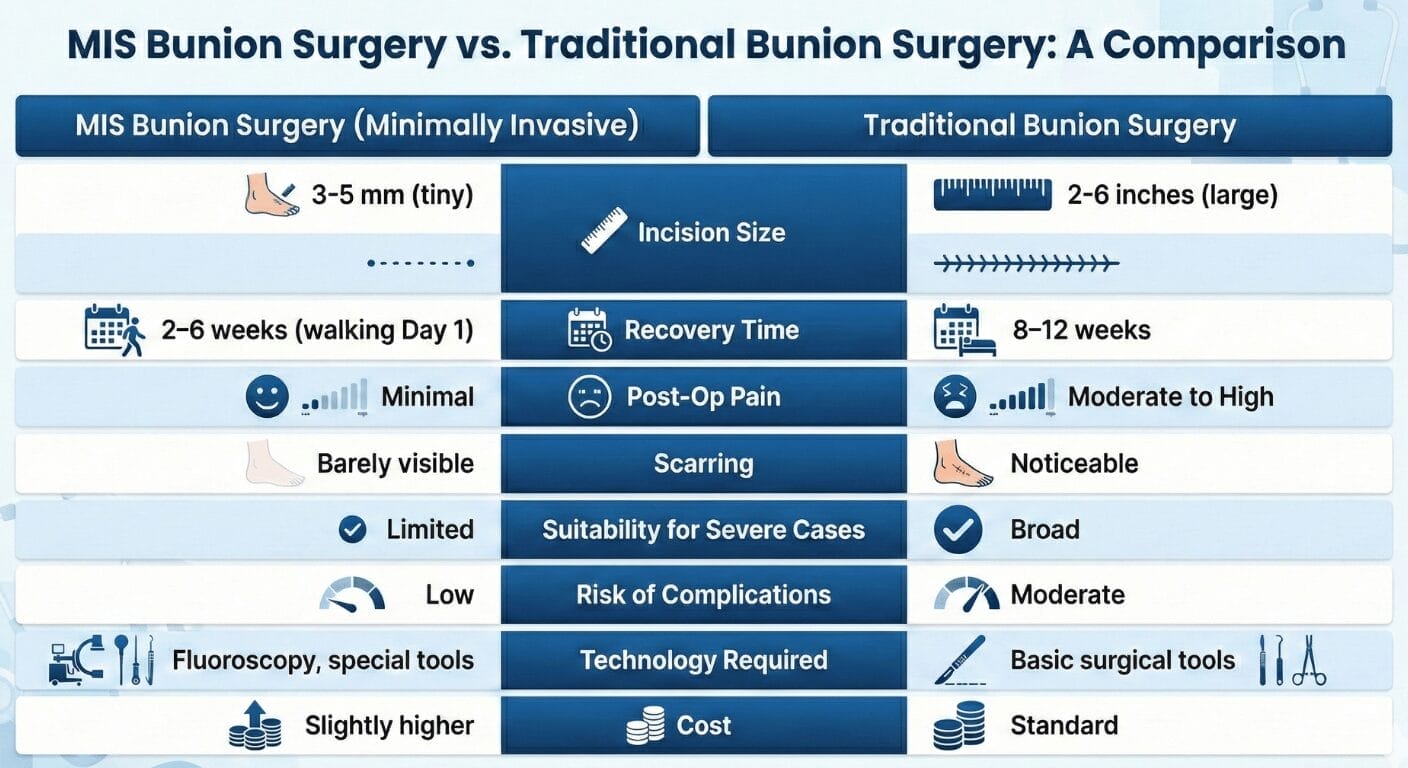
MIS techniques work brilliantly for a wide range of mild to moderate bunions. Our foot and ankle specialists typically consider these factors:
For example, we recently treated a young Miami-based teacher who needed to be back on her feet quickly. MIS allowed her to walk right after surgery and return to work within two weeks with minimal pain and nearly invisible scars.
In some cases, a more extensive, traditional approach is still the best option:
This method gives the surgeon the ability to fully visualize the joint and make precise corrections.
At SFL Medical Group, we don’t believe in a one-size-fits-all solution. Instead, we follow a personalized decision-making framework:
This approach ensures that our patients are part of the decision-making process and most importantly, that the chosen procedure supports long-term outcomes.
A 54-year-old female marketing executive in Miami had been battling bunion pain for years. Constant Zoom calls weren’t the problem; walking between meetings in heels was.
After assessing her lifestyle and mild-to-moderate bunion stage, we recommended MIS surgery. She walked the day of surgery, wore stylish flats within three weeks, and returned to Pilates within eight weeks. Her only regret? Not doing it sooner.
We’re proud to lead the way in minimally invasive foot correction in the Miami area.
If you’re navigating painful bunions and debating which surgical route offers the best outcomes, let’s talk. At SFL Medical Group, we combine innovation with decades of specialization to deliver results that last.
Schedule a consultation and let’s find the right fit for your feet and your future.
When most people picture arthritis, they think of aching knees or swollen finger joints, not a dull ache in the lower back that shows

Joint pain, swelling, deep tiredness and morning stiffness. That list could describe rheumatoid arthritis or lupus, and plenty of people spend months wondering which